
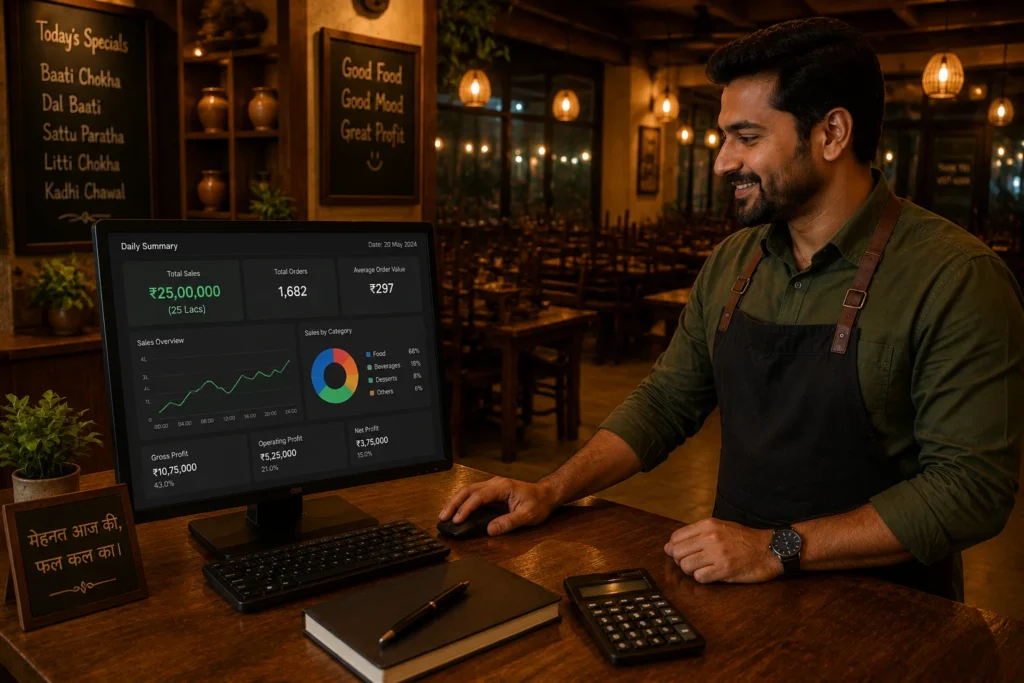
Almost everyone who dreams of opening a restaurant asks the same question at some point: how much money does a restaurant actually keep after all the bills are paid? It sounds like a simple question, but the honest answer is that it depends heavily on the type of restaurant, its location, and how tightly it is run. This guide breaks down restaurant profit margins in plain terms: what they mean, what typical numbers look like across different formats in India, what pulls them down, and what actually moves the needle.
What Is a Restaurant Profit Margin, Really
A restaurant profit margin is simply the percentage of money left over once every expense has been paid: food cost, salaries, rent, electricity, marketing, taxes, and maintenance. Whatever survives that list is profit.
Here’s a way to picture it that most people already understand from their own paycheck. Your gross salary is the big number on your offer letter. What lands in your bank account after tax, PF, and other deductions is a smaller number. A restaurant works the same way. There’s a gross number (total food sales), then several layers of deductions, and what survives all of them is the actual profit the owner takes home.
Gross Profit Margin
This is revenue minus the direct cost of preparing the food: raw materials, ingredients, packaging, and kitchen consumables. It tells you how efficiently the kitchen itself is run, before rent, staff, or marketing enter the picture.
Operating Profit Margin
This subtracts the everyday cost of running the business: salaries, rent, utilities, marketing, maintenance, and software subscriptions. It shows how efficiently the restaurant runs as a whole, not just the kitchen.
Net Profit Margin
This is what remains after every single expense, including taxes, interest, and depreciation. This is the real number, the one that actually reaches the owner’s pocket at the end of the month.
What Counts as a Good Restaurant Profit Margin in India
There’s no single correct number here, since industry sources report fairly different ranges depending on how tightly they define “profit” and which cost lines they include. But a reasonable, commonly cited range looks like this:
| Restaurant Type | Typical Net Profit Margin |
| Quick Service Restaurant (QSR) | 8 to 15% |
| Casual Dining | 10 to 18% |
| Fine Dining | 8 to 15% |
| Cloud Kitchen | 12 to 25% |
| Well-managed Franchise | 10 to 20% |
Industry benchmarking from sources like DineOpen’s 2026 restaurant margin guide and FranchiseIndia’s coverage of India’s QSR sector shows a similar spread, though cloud kitchens in particular can swing widely depending on how much of their revenue comes through aggregator platforms versus direct orders, since platform commissions alone can run 25 to 30% of an order’s value.
The takeaway: don’t chase the highest number you’ve seen quoted online. Every format has a realistic range, and landing inside that range consistently matters more than any single month’s headline number.
What Actually Moves These Numbers
Food Cost
Food cost is usually the single biggest expense a restaurant carries, generally somewhere between 28 and 35% of revenue. If it climbs meaningfully above that, it usually means one of two things: ingredients have gotten more expensive, or the kitchen isn’t controlling portions and waste well.
Think of it the way most households handle grocery shopping for a big family dinner. Buy too little and you run out mid-meal. Buy too much and half of it spoils in the fridge by the weekend. A restaurant faces that exact tension on every single ingredient, every single day, just at a scale where the mistakes cost a lot more than a wasted bag of tomatoes.
Ways owners typically keep this in check: standardised recipes, strict portion control, dependable suppliers, regular inventory tracking, and a real effort to reduce waste rather than just track it after the fact.
Rent
Location is a trade-off, not a free win. A high-visibility spot pulls in more walk-in customers, but it usually comes with rent to match. The skill is in finding the spot that earns its rent back through footfall, rather than the spot that simply looks impressive.
Employee Costs
Labour is typically the second-biggest cost line after food. Efficient scheduling, proper training, and right-sized staffing (not overstaffed for slow hours, not understaffed during the dinner rush) make a real difference here.
Menu Pricing
Price too low and margins evaporate no matter how many people walk in. Price too high and demand quietly drops before you even notice why. Menu pricing needs regular review against ingredient cost, competitor pricing, and how each dish is actually performing on your sales reports, not just gut feel from when the menu was first written.
Customer Footfall
More customers generally means more revenue, but footfall doesn’t grow on its own. It usually needs a push: digital marketing, an optimised Google Business Profile, loyalty programs, seasonal offers, and a presence on delivery platforms.
Food Delivery
Delivery genuinely expands how many customers a restaurant can reach, but it comes at a real cost: platform commissions, packaging, and delivery-specific discounts all eat into the margin on every online order. A restaurant that leans too heavily on delivery without watching this balance can end up doing more sales and less profit at the same time, which is a trap many owners don’t notice until they actually sit down with their numbers.
The Common Expenses Every New Owner Should Budget For
Before anyone calculates profit, it helps to have the full expense list in front of them:
- Commercial rent
- Kitchen equipment
- Furniture
- Employee salaries
- Food ingredients
- Utilities
- Internet and POS software
- Licences and compliance
- Marketing
- Repairs and maintenance
- Cleaning supplies
- Taxes
- Insurance
Missing even two or three of these from a launch budget is one of the most common reasons new restaurants run into cash flow trouble in their first year.
Why Franchises Tend to Protect Margins Better
Starting an independent restaurant gives you complete creative control, but it also means building every single system yourself, from the recipe to the supplier relationships to the marketing playbook, with no earlier version to learn from.
A useful comparison here is Amul. Amul didn’t build one of India’s largest food businesses by charging a premium on every packet of milk or butter. It built it by keeping costs so disciplined that even a thin margin, multiplied across millions of units sold every single day, adds up to a genuinely large business. Franchises work on a similar logic at restaurant scale: the margin on any single plate might look ordinary, but a tested system, standardised recipes, an established supplier network, staff training already worked out, and marketing support, means fewer expensive mistakes eating into that margin along the way.
That’s typically why franchise partners become profitable faster than a first-time independent owner figuring out the same lessons alone. Many food brands built around traditional Indian cuisine, for instance, combine an established name with standardised kitchen operations, so a franchise partner can focus on running the outlet well rather than inventing the whole system from scratch.
Practical Ways to Improve Restaurant Profit Margins
None of these are dramatic changes. Most successful restaurants improve margins through a series of small, boring, repeated actions:
- Reduce food waste through better portion control and inventory tracking
- Simplify the menu so the kitchen isn’t juggling too many low-selling dishes
- Improve table turnover during peak hours
- Introduce combo meals that lift average order value
- Build repeat customers through loyalty programs, since a repeat customer costs far less to serve than one acquired through fresh advertising
- Use inventory management software instead of manual tracking
- Review daily sales reports rather than only monthly ones
- Train staff to upsell naturally, without it feeling forced
- Review supplier contracts periodically instead of assuming last year’s rate still holds
Is Running a Restaurant Actually Profitable
Yes, when it’s managed with discipline. The restaurants that stay consistently profitable tend to share a few habits: steady food quality, a strong customer experience, tight cost control, efficient day-to-day operations, sensible marketing, and a location chosen with the numbers in mind rather than just the address.
Profitability, in other words, has less to do with serving the most customers possible and more to do with running the business efficiently every single day, the unglamorous part of the job that rarely gets talked about but decides almost everything.
Final Thoughts
Revenue gets most of the attention when people talk about restaurants, but long-term success actually comes down to managing costs, delivering a consistent experience, and running operations efficiently month after month. Whether you’re planning an independent restaurant or weighing a franchise opportunity, understanding where your margin actually comes from, and where it quietly leaks away, is the difference between a restaurant that survives its first year and one that doesn’t.