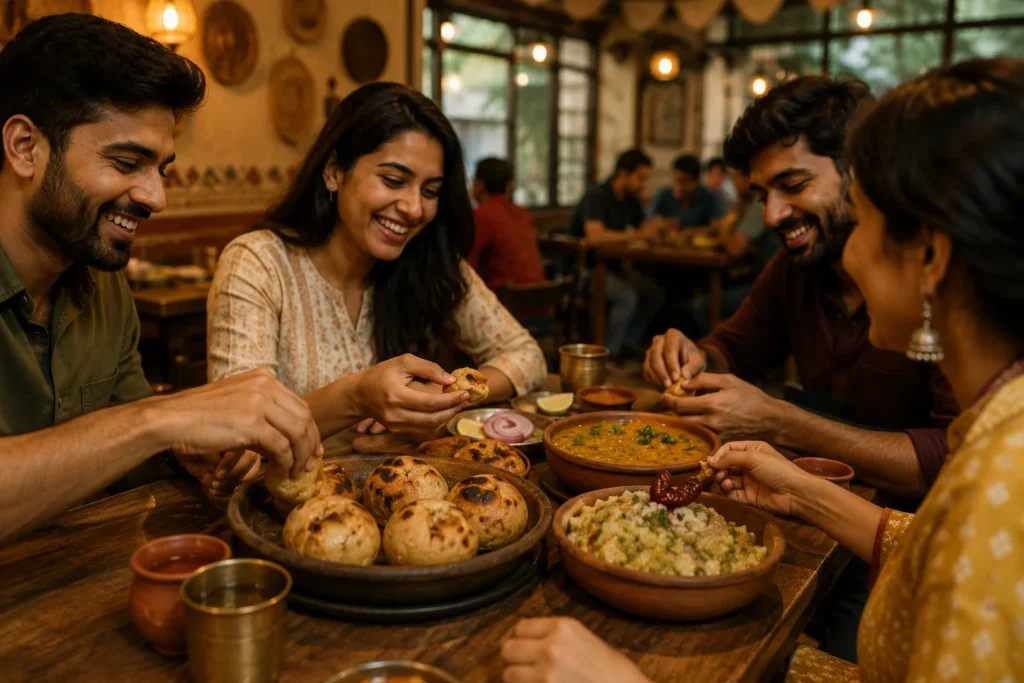
If you’ve ever eaten a smoking-hot baati straight off a wood fire, dunked in ghee and paired with sattu-stuffed paratha and mashed chokha, you already understand something most new food brands spend years trying to manufacture: an emotional memory that doesn’t fade with fashion. That is the idea behind the Baati Chokha franchise, a business built not on inventing a new craving, but on packaging one that already exists in millions of Indian households, and giving it the systems and branding needed to run at scale.
India’s food service industry is in a strong growth phase. According to the National Restaurant Association of India’s India Food Services Report 2024, the sector is projected to reach close to ₹7.76 lakh crore by 2028, growing at an 8.1% CAGR and making India the third-largest food services market in the world, ahead of Japan. Within that growth, regional and traditional cuisine is one of the fastest-moving categories, standing apart from the QSR burger-and-fries formula that shaped the last two decades.
This is the gap Baati Chokha, founded in 2020 and recognised under Uttar Pradesh’s One District One Product (ODOP) initiative, has built its business around: authentic North Indian and Purvanchal food, run through a standardised, franchise-ready restaurant model.
This guide covers what a Baati Chokha franchise actually involves: the investment formats, real setup costs by city tier, breakeven timelines, what the brand provides versus what the franchise partner funds, and the questions most first-time buyers ask before signing.
Every few years, a new food trend takes over India, a particular bubble tea format, a viral dessert, a fusion cloud kitchen concept. Most of them show up fast, get crowded with copycats within months, and quietly disappear once the novelty wears off. Traditional food doesn’t play by that clock. Haldiram’s is a good example: it started as a small sweet shop in Bikaner selling traditional Indian snacks, and decades later it’s a company worth thousands of crores, still selling largely the same bhujia and namkeen recipes it started with, while dozens of trendier snack brands have come and gone in that time. Nobody had to be convinced to like baati chokha either. It was already part of their childhood.
That steadiness shows up in industry data too. NRAI’s coverage points to rising urban demand for authentic traditional dishes even as trend-led, digital-first food categories cycle in and out of relevance every couple of years. For an entrepreneur, that means you’re not betting on a category recovering after a dip. You’re betting on something that has already survived every food trend since Independence.
Starting an independent restaurant is a bit like building a house from an empty plot of land, versus buying a flat that’s already constructed, wired, and painted. Both get you a place to live, but one means you’re also dealing with the architect, the plumber, the electrician, and every delay in between, all before you’ve moved in a single chair. That’s exactly why brands like McDonald’s or Subway spread so quickly across small towns: the founder solves the hard problems (the recipe, the pricing, the staff training) once, tests it for years, and every franchise partner after that simply moves into a model that already works. A Baati Chokha franchise partner is solving the craft problem (recipes, sourcing, kitchen operations) and the business problem (branding, staffing, marketing, customer trust) at the same time when starting from scratch, usually with limited capital and no room for expensive mistakes.
An independent restaurant typically requires tackling all of this at once:
A Baati Chokha franchise replaces most of that guesswork with a tested system: standardised recipes, established branding, and a fitted-out kitchen, so partners start from a working model instead of a blank page.
One thing the Baati Chokha – Gaav ki Kala franchise structure gets right is that it does not force every entrepreneur into the same size of bet. There are two broad tracks: a compact studio outlet format, and a full dine-in restaurant format priced by city tier.
This is the entry format, built for takeaways, deliveries, and a small studio-style outlet rather than a full dine-in restaurant.
Based on the brand’s own projections for a 200 sq. ft. outlet, monthly sales start around ₹4.95 lakhs in the first month and climb toward ₹9.92 lakhs at an “ideal” run rate, with profit margin moving from about 15% in month one to roughly 32% once the outlet stabilises.
This is the dine-in format, priced differently depending on the city tier the outlet is set up in, since real estate and operating costs vary sharply between metros and smaller cities.
| City Tier | Cost (with roof/land) | Cost (without roof/land) | Reported Breakeven |
|---|---|---|---|
| Tier 1 | ₹4,000 per sq. ft. | ₹5,000 per sq. ft. | 9 to 10 months |
| Tier 2 | ₹3,000 per sq. ft. | ₹3,750 per sq. ft. | 9 to 10 months |
| Tier 3 | ₹2,500 per sq. ft. | ₹3,000 per sq. ft. | 9 to 10 months |
Across all three tiers, the franchise fee is reported at ₹15 lakhs, and the brand’s projected numbers show a similar pattern: sales and profit margin both climb steadily from month one to month four or five as the outlet builds its regular customer base and online order volume. In the Tier 1 model shown, for instance, projected monthly sales rise from about ₹17.6 lakhs to nearly ₹39 lakhs at an ideal run rate, with profit margin moving from 12% to 35% over that period. Tier 2 and Tier 3 outlets follow a similar curve, scaled to their lower per-square-foot costs and correspondingly lower sales base.
These are the brand’s own projected figures and will vary by actual location, footfall, and execution. Treat them as a planning reference, not a guarantee.
A useful way to think about a franchise agreement is as a checklist split into two columns: what arrives ready-made, and what you’re responsible for keeping running.
Typically included by the brand:
Typically the franchise partner’s responsibility:
On top of setup costs, ongoing expenses shown in the brand’s own P&L models include a 7% royalty on sales, food cost and packaging at roughly 30% of sales, and online aggregator commissions (Swiggy, Zomato, and similar) also around 30% of online order value. Staff salaries, rent, electricity, and fuel (coal and gas, since the format uses tandoor cooking) round out the recurring cost base.
The Baati Chokha model tends to attract a fairly specific set of profiles:
No franchise system, however well built, can make up for a weak location. Site selection remains the one lever a franchise partner controls directly, and it decides most of the outcome. Locations that tend to work well for a dine-in-heavy format like this include high streets, established commercial markets, shopping complexes, dense residential neighbourhoods, tourist destinations, and highway stretches with strong vehicle footfall.
The right location does three things at once: it builds visibility, it drives the daily footfall needed to hit breakeven within that reported 9 to 10 month window, and it compounds into long-term profitability once the outlet becomes a known destination rather than a discovery.
India’s food service market isn’t just growing, it’s growing toward authenticity. As delivery aggregators and generic QSR formats fill up the metro food scene, differentiation increasingly comes from cuisine that ten competitors in the same food court can’t easily copy. Brands that pair that cultural authenticity with the operational discipline of a proper franchise system, standardised recipes, trained staff, consistent branding, are the ones best placed to grow with this shift rather than get replaced by the next one.
It’s also worth noting the policy timing: in January 2026, the Union Home Ministry formally launched the One District, One Cuisine (ODOC) initiative in Uttar Pradesh, extending the ODOP idea specifically to food, with a focus on giving each district’s signature dish institutional identity, hygiene standards, and visibility. Brands already operating in this space before that policy push arrived are, in effect, ahead of a curve the government is now actively supporting.
For entrepreneurs weighing a Baati Chokha franchise, the opportunity sits at a practical intersection: a category with steady, multi-generational demand, early institutional recognition, and clear published numbers on setup cost and breakeven by city tier. The next step is a direct conversation with the brand to check current terms against your specific city and site.